Exhibits Focus on Legacy of the Declaration of Independence
During the Civil War, Abraham Lincoln looked to the nation’s founding documents for guidance, especially the Declaration of Independence, which he called the nation’s “Apple of Gold” because of its message of equality. In the Gettysburg Address, Lincoln connected the Civil War to the principles of liberty and human equality expressed in the Declaration. By doing so, he reinforced the idea of the United States as a symbol of hope and freedom.
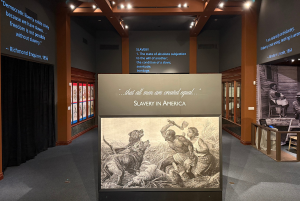 The Lincoln Memorial Shrine’s commemoration of the Declaration of Independence began in February 2025 with the opening of “ … That All Men Are Created Equal: Slavery in America,” an exhibit exploring slavery and its legacy in the United States. Providing a look at the experiences of enslaved people from the precolonial period through emancipation, as well as the long-lasting effects. Utilizing selected documents from the newly-acquired Slavery in America Collection and items from the Shrine’s pre-existing collections, the exhibition takes a thematic approach, highlighting specific stories that bring to life the experiences of enslaved people, including the methods of control imposed by enslavers, the journeys to self-emancipation by freedom seekers, the efforts of abolitionists, the immediate effects of emancipation, and the aftermath of that liberation.
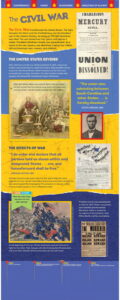 A new exhibit, “Becoming the United States: Colonial America to Reconstruction,” by The Gilder Lehrman Institute of American History, explores the foundational people, events, and diverse communities that built the United States from the early colonial-era through the Reconstruction period. To celebrate the 250th anniversary of the Declaration of Independence, the Lincoln Memorial Shrine presents “Becoming the United States: Colonial America to Reconstruction,” an exhibit exploring America’s early history and founding documents. Created as part of the National Endowment for the Humanities’ “A More Perfect Union” project, “Becoming the United States” utilizes digital images of materials from the Gilder Lehrman Institute’s collections. Some of the highlights include an engraving of Africans being transported to the Americas around 1800, a War Department reward poster for John Wilkes Booth from April 20, 1865, and a postwar freedman’s sharecropping contract.
Both exhibits will be on view through January, 2027.