Honoring the Sesquicentennial of the Civil War –
1861: And the War Came

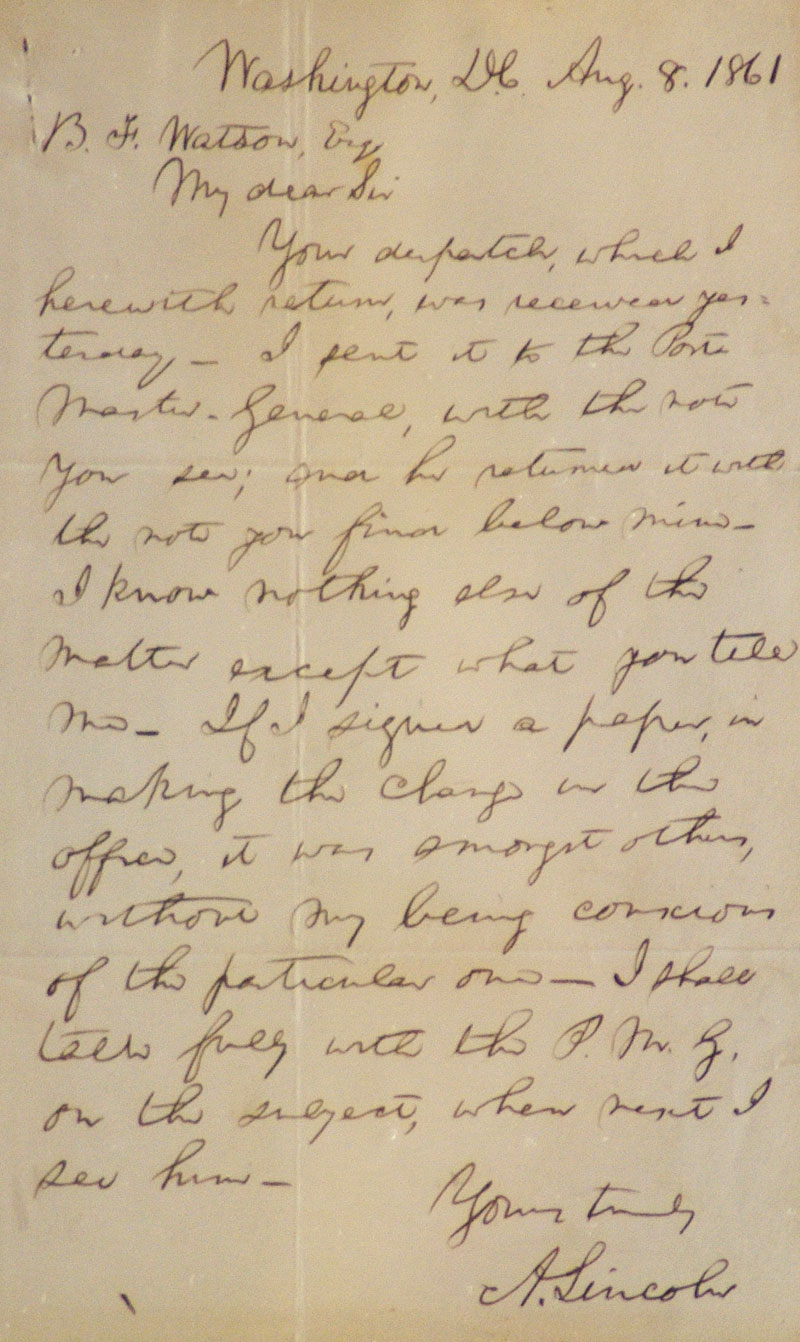
The American Civil War has been aptly described as the cross-roads of American history, the period when America transformed from a rural, predominantly loose confederation of disunited states, to an industrialized, more federal nation that would soon assume a greater role on the world stage. The conflict itself was by far the most sanguine in our history, with 626,000 soldiers losing their lives – almost as many as all other American wars combined. “And the War Came” focused on the dramatic events of 1861. The exhibit featured manuscripts, artwork, and artifacts that examine the causes of the war.
Some major themes included in the timeline:
- The Secession Crisis – The election of Abraham Lincoln as our first Republican president convinced seven slave-holding southern states to secede from the Union. Why did they perceive him to be such a threat?
- Fort Sumter – After Lincoln’s election, the South demanded that the Federal fort in Charleston Harbor be evacuated. By refusing, Lincoln maneuvered the South into firing the first shot, thereby rallying previously lukewarm Northern support for war.
- The Border States – Despite being slave-holding states, Maryland, Delaware, Missouri, and Kentucky stayed loyal to the Union. How did Lincoln manage to prevent their secession?
- The Battle of Bull Run – The politicians and newspapers in the North were convinced that one big battle would end the Southern rebellion. The sharp defeat at Bull Run would shatter that illusion.
- The Battle of Ball’s Bluff – This little known Union defeat in Virginia would have significant repercussions as it would lead to the creation of the meddling congressional committee on the conduct of the war, a major thorn in Lincoln’s side during the remainder of the conflict.
- The Mason-Slidell Affair – Also known as the Trent Affair, the Union seizure of two Confederate diplomats from a British vessel threatened to lead to war between the United States and Great Britain. Could Lincoln afford more than one war at a time?
As the year ended, how much progress had Lincoln made towards his goal of ending the Southern rebellion and restoring the Union?
1862: This Fiery Trial

“Battle of Fort Donelson” (Library of Congress)
“1862: The Fiery Trial,” a special exhibit focusing on the events of the second year of the Civil War, used manuscripts, artifacts and artwork to demonstrate how the war intensified in its second year, with battles such as Fort Donelson, Hampton Roads, Shiloh, the Seven Days, Second Bull Run and Fredericksburg taking an ever-increasing toll of lives. Particular emphasis was given to the crucial battle of Antietam, still the bloodiest day in American history and a victory that persuaded President Lincoln to issue his war changing Emancipation Proclamation.
1863: The Turning Point

“Vicksburg Missp. and the Rebel batteries 1863” (Library of Congress)
“1863: The Turning Point” delved into the pivotal year in the war when President Abraham Lincoln issued the Emancipation Proclamation, which changed the nature of the conflict from a war for union into a war for freedom. Victories at Vicksburg and Gettysburg in July 1863 helped turn the tide on the battlefield. However both victories were not fully exploited and much hard fighting remained.
1864: This Mighty Scourge of War

“Siege of Atlanta”, facsimile print by L. Prang & Co (Library of Congress)
“1864: This Mighty Scourge of War” was the fourth installment in the Shrine’s series commemorating the sesquicentennial the Civil War. Original manuscripts from figures such as Abraham Lincoln, Mary Lincoln, General Ulysses S. Grant, and General William Tecumseh Sherman were combined with contemporary and current illustrations to convey the important developments of the fourth year of the war. These include the presidential election of 1864, Sherman’s March to the Sea, the Battle of the Crater, Mobile Bay, and the Wilderness.
1865: Triumph and Tragedy

“The surrender of Lee,” 1885 (Library of Congress)
The final installment of the sesquicentennial exhibition series “Triumph and Tragedy” examined the events of 1865, the ultimate year of the war and Lincoln’s presidency. The dual extremes of the first half of the year served as the organizing principles for the exhibition. From the triumphs of the defeat of the insurgent armies and the passage of the Thirteenth Amendment to the Constitution by the Congress, to the tragedies of the murder of President Lincoln with an assassin’s bullet and the death of some 1,800 released US prisoners of war in the greatest naval disaster in the country’s history, the exhibition wove several themes together to tell the story of this pivotal moment for the nation.